We refer to male Balanitis, which is an inflammation of the glans (the head) of the penis. Posthitis is inflammation of the foreskin. The foreskin or prepuce is the loose skin that covers the head of the penis if the male has not been circumcised (intact). Balanoposthitis is when both the glans and the foreskin are inflamed.
Balanitis can occur at any age, but is more likely to affect boys under four years of age, as well as adult males who are intact. It is a very common condition, affecting approximately 1 in every 25 boys and 1 in 30 intact males (at some stage in their life). Balanitis is considered rare among circumcised adult males.
Balanitis can have both infectious and non-infectious causes. It is more common in patients with phimosis (tight foreskin). It is reported in the peer reviewed medical journals that patients with mellitus (Type 1) are more susceptible to developing balanitis.
Chronic (long-term, recurring) balanoposthitis increases the risk of developing balanitis xerotica obliterans (chronic dermatitis, most often involving the glans and foreskin), phimosis (tight foreskin), paraphimosis (when the foreskin is retracted it cannot return to its original location), and penile cancer.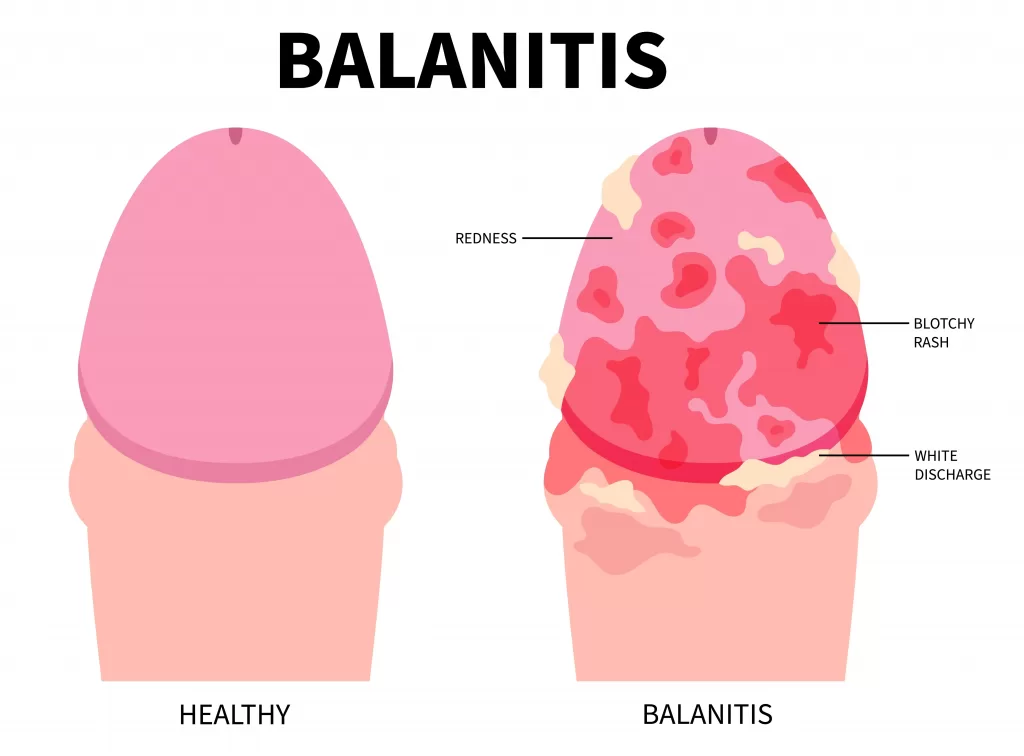
What are the symptoms and signs of balanitis?
A symptom is something felt (pain, nausea, itch) and a sign is something that can be observed (skin colour, pulse rate, discharge etc.). Signs and symptoms of balanitis may include:
- The area around the glans (head of the penis) is red
- Inflammation of the glans
- Soreness of the glans
- Irritation of the glans
- Under the foreskin there may be a lumpy, thick discharge
- Itchiness around the glans area
- An unpleasant smell
- Phimosis – the foreskin is tight and does not retract (can’t pull it back)
- Painful urination
- The soreness, irritation and discharge under the foreskin typically occurs two to three days after sexual intercourse
What are the treatment options for balanitis?
Treatment for balanitis depends on the cause. In most cases the doctor will advise on what substances to avoid, and give the patient information on hygiene.
Allergic reaction – if the inflammation is thought to be caused by an allergic reaction or some irritant the doctor may recommend Novoglan Cream or prescribe a mild steroid cream, such as 1% hydrocortisone, for the swelling. An anti-fungal or antibiotic treatment like Novoglan Cream and Soap or medication may also be prescribed. If there is an infection the patient should not use a steroid cream on its own. All soaps and other potential irritants should be avoided during treatment, and until signs and symptoms have completely gone.
Candida (yeast infection) – the doctor will recommend an antifungal cream like Novoglan, or prescribe products like clotrimazole or miconazole. The patient’s sex partner should also be treated. While treatment is underway he should either abstain from sex or use a condom.
Bacterial infection – the patient will be prescribed an antibiotic, such as erythromycin or penicillin.
If a trial of a treatment like Novoglan is tried but symptoms persist, the GP determines that there is no infection and no irritant has been identified, the patient may be referred to a dermatologist (a doctor specialized in skin conditions), or a genito-urinary clinic.
Phimosis and recurrence – if the patient has a tight foreskin and the balanitis keeps coming back, the doctor might suggest the use of the Novoglan Gentle Foreskin Stretcher or for more radical action – circumcision.

